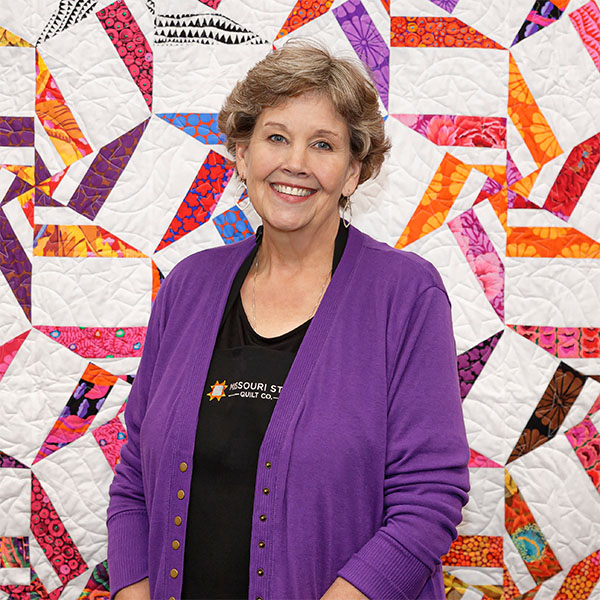


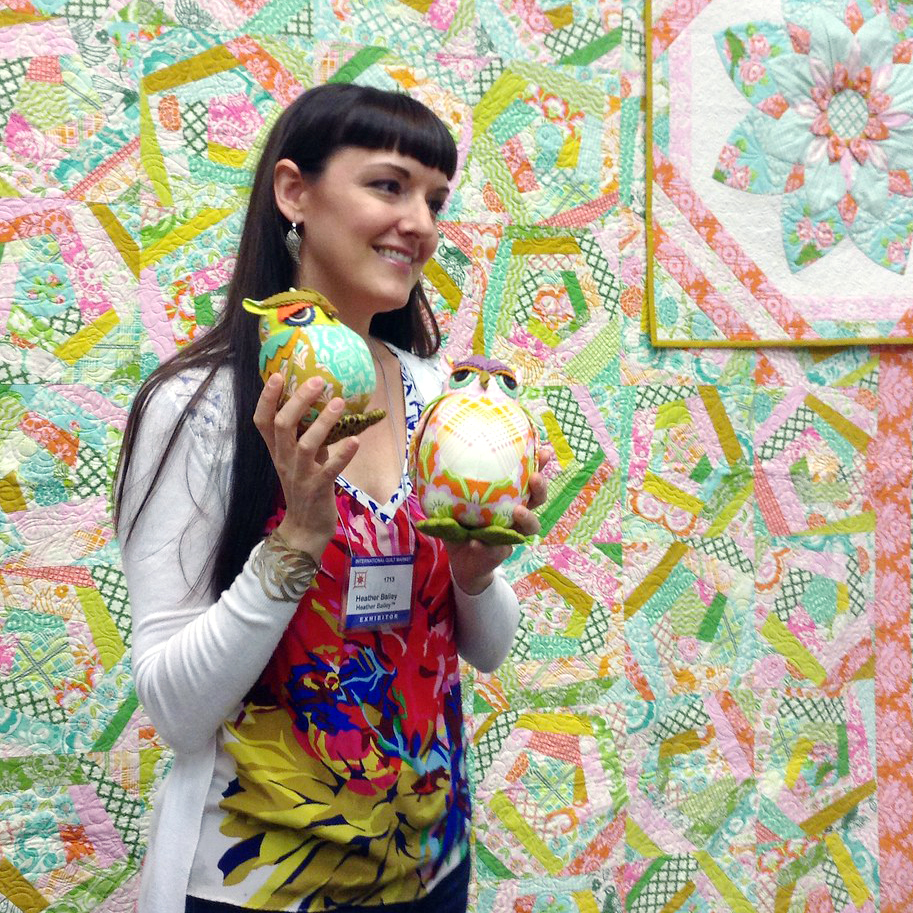
Meet Heather Bailey, a full-time professional artist, a patented inventor—and a world-re- knowned star in the textile, craft, and decorating arena. With her sophisticated floral designs and smart geometric prints, Heather has inspired a new generation of crafters and home decorators to embrace art and color in their everyday lives.
Heather’s creations, including fashion and home-decor items, have sold worldwide in the best stores: Fred Segal, Henri Bendel’s, Bloomingdales, and more. InStyle, Glamour, Mademoiselle, Seventeen, Country Living, and other top publications have all highlighted her unique fabrics and creative designs. Heather has contributed to books on business and on personal style. And, she has published dozens of innovative quilt patterns, sewing patterns, and embroidery patterns for the sewing industry.
What is your favorite part of the quilting process?
I particularly love to bind a quilt by hand. As the sole provider for a young family with more than one business to run, I rarely sit on the couch! So, finishing up a quilt not only delivers the satisfaction of a completed project, but it also offers my best chance to relax into the soft, comfy couch with my kids and watch a movie together. I know that some quilters dread this step, but I love it!
Who are your favorite fabric designers?
I am intrigued by the simplicity of architect, C.F.A. Voysey’s art-nouveau-style textiles and the versatility of Florence Broadhurst’s work, from groovy mid-century geometrics to elegant, detailed florals. As for current designers, I particularly enjoy Brandon Mabley’s work. He is a joyful, delightful person and his enthusiasm for playful design and bold color is reflected in his fabric designs every time. He makes me smile.
What notion or sewing tool are you most dependent on?
Barbara Willis offers a tool called The Stuffing Fork. It used to be available in stores, but now it’s only available on her website, I think, so it’s pretty obscure at this point. It’s a simple, skinny metal bar with a plain handle on one end. At the other end, the metal bar has a slit cut into it. This minimal design is truly the most amazing stuffing tool I’ve come across. It grabs a bunch of stuffing like nobody’s business. It does a marvelous job at packing gobs and gobs of fluff into even the smallest areas when needed. All of my popular pincushion designs are stuffed firmly, and I use The Stuffing Fork every time. This approach not only gives the pincushions a nice weight on the table, but it also rounds out the forms of each design for a polished, professional result.
I love the fine-point water-soluble marking pen that Clover makes. It outlasts its competitors and provides a crisp blue line every time. I use the Clover pen to mark fabrics as needed for all of my sewing patterns and embroidery patterns.
I adore the edge-stitching for my sewing machine. The blind-stitching foot does the trick too. They each have a vertical metal plate at the center of the foot which guides a folded fabric edge through the machine. With the needle positioned off-center, this guide provides a stitched line which runs perfectly parallel to the fold. It’s the ideal tool for professional-looking top-stitching—which comes in handy for a variety of homespun projects like aprons, totes, tablecloths, machine covers, etc.
How were you introduced to sewing and quilting?
My first craft obsession was paper. At 4-years-old, I filled my bottom dresser drawer with heaps of paper: white paper, lined paper, construction paper—any paper I could get my hands on. With the assistance of a stapler, scissors and glue, I’d busy myself for hours building all sorts of intricate 3D creatures, from robots to elephants.
When I was eight, my family and I went on a vacation to the mountains. At some point in the stay, my father parked our van near a trail-head and left the vehicle to investigate whether he wanted to explore this area or move onto another trail. My mother was in the van with us, knitting in the front seat.
My father was gone for what seemed like forever to me at that age and I was incredibly bored. I eventually asked my mom if she would show me how to knit. Instead, she pulled out a crochet hook and taught me the basic single-crochet stitch. Before my dad was back to the van, my Barbie had a brand-new skirt. That was my very first foray into textiles.
With the gift of a small Learn-to-Crochet book, I took off with my new hobby and became a crocheting dynamo. I made purses, and I designed clothing for my dolls. Teachers at my school ordered gifts for their children. Third grade, age eight—my first business! Once, I crocheted a three-foot long banana slug after I returned from sixth-grade camp in the redwoods—partly due to a lack of resources as my only yarn at the time was an enormous cone of coarse yellow yarn that I had picked up at a thrift store.
I also started sewing while in elementary school. My first project was a pair of flip flops made from terry cloth and cardboard. Again, this somewhat-silly project was born of the materials I had on hand; when the sewing bug bit me, the only fabric I had access to was a nest of terry-cloth scraps in my mom’s closet.
With permission to use her sewing machine, I set up a table in my bedroom, shut the door, and studied the machine’s buttons and dials until I had something that resembled a stitched line feeding out of the machine. I wish I had a picture of those flip flops. I don’t think I ever wore them beyond the few small steps from my room to the kitchen to show them off to my family.
In junior high school, my skill level improved by leaps as I reconstructed clothing and sewed outfits from scratch. Pants became skirts, old tee shirts became headbands and my first love, Steve, received a plush, articulated teddy bear dressed in a Michael-Jordan jersey for Valentine’s Day.
In high school, I learned quilting. My mother knew all of the tips and tricks for perfect piecing so I was very good at it from the start. My first quilt was for my own bedroom, but every other quilt I made for the next fifteen years was given to a friend or family member. The perfect gift! There aren’t many gifts that someone will use and enjoy every day for years and years and know that they are loved.
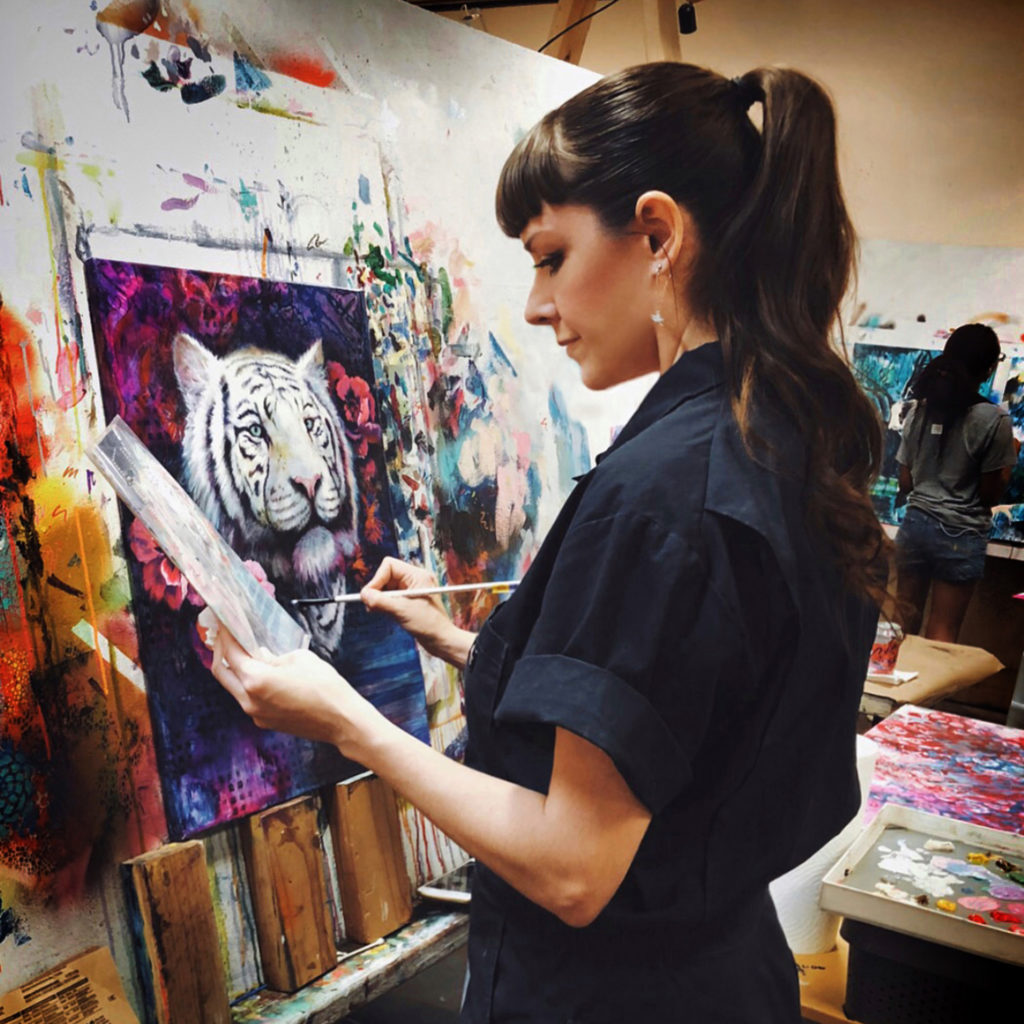
By the time I was 17 and in college, my preoccupation with all things handmade picked up serious speed and I soon learned my way around many new arts: knitting, spinning, weaving, stained glass, upholstery, ceramics, bead making, faux finishing, silver smithing, illustration, and painting. I received my Bachelor’s Degree in Clothing in Textiles at age 20.
What was the most frustrating sewing project you ever worked on?
I once made a clutch purse from an expensive orange-and-red tie-dyed goat pelt someone gave me. I combined this with crocodile-embossed red patent leather which was just too thick for my machine. I was determined—and there was a lot of hammering on a wooden block to try to compress the material. I got through it, but the purse didn’t have the crisp, professional lines I was going for. The top edge of the purse needed more structure and more layers than I could dare tackle with a standard home-sewing machine.
What do you do to find inspiration/encourage your creativity?
My favorite hobby is “Learning New Things.” I listen to audio-books and podcasts nearly every day. I learn about psychology, history, art, writing, family systems, cooking, barn-building, you name it. On average, I consume the equivalent of two or three books every week. When my mind is engaged in new ideas, albeit from a diverse range of topics, I’m able to simultaneously dive into creative auto-pilot. It’s like one half of my mind is happily learning while the other half of my mind is happily drawing, painting, or sewing—and they don’t get in each other’s way. The information doesn’t need to remotely relate to what I’m
creating. I could be learning about the Bay of Pigs while drawing a peony floral design.
The only time I cannot multi-task like this is when I am writing. Writing requires my full focus! So, as long as there are new topics I’m curious about and I’m feeding my mind a steady stream of intellectual input, creative output comes as a natural byproduct. There is so much to learn, thank goodness, I don’t imagine the fountain of creativity will ever run dry.
What occupation would you like to try if sewing/making wasn’t an option?
This is a tough one because when I want to do something, I do it! I find a way to fit it all in. If sewing weren’t an option, I would focus my energies on fine-art painting, and I would build my body work in that realm. However, if I couldn’t make visual art of any kind—fabric, quilts, paintings, and so forth—then I would spend all of my professional creative energy writing and teaching—spreading my love for art, color, design, innovation, business, family, and the creative life.
Who is your favorite fictional character?
Elf—because “smiling is my favorite!” and enthusiasm is my love language.
What fabric have you been hoarding/saving the longest?
I once stumbled across a set of my exact childhood bedsheets on eBay—peachy butterflies and flowers on a yellow pastel background. I snatched them up! I figured if I gave them a deep, deep clean, they could make their way into two quilts one day—one for me and one for my older sister with whom I shared a room. We had matching bedding. I also came across the exact fabric that my mom used for appliques in my very-first homemade blanket when I was three or four. I jumped at the chance to buy that piece, but it disappeared right when I put it in my cart. I messaged the seller through other listings and gave it a good go, but I never heard back. Boo!
Describe your perfect day.
The “perfect day” seems like a fiction to me, so I’m going all in. I wake up in Paris. My own good man gives me a big, warm hug and we chitchat about the latest things we are reading or learning while I get ready for my day. I feed the kids a warm breakfast and set them up with their own ideal activities. Then I head out into the sun to ride my bicycle to a morning painting lesson from the reincarnated John Singer Sargent. I magically absorb all that he could ever teach me in those short three hours. At a corner cafe, I enjoy a baguette sandwich while I plot out a new fabric collection in my sketchbook. Along comes David Bowie, also reincarnated, who sees one of my paintings rolled up in my bicycle basket and stops to inquire. He commissions me for a giant portrait of him. We brainstorm what outlandish costumes he might wear—the weirder, the better. I agree to draft the costume
pattern and make it happen. We call my teenage daughter who nearly faints when David Bowie says hi.
I have to get going. I have a meeting with my publisher about my book on tenacious creativity. I stop by a charming chocolate shop on the way back to my family and pick up a giant bouquet of pink peonies with pops of craspedia—my favorite fresh-flower combination. With carefree abandon, we eat at all of the chocolates before dinner and share stories from the day. After dinner, we snuggle up on the couch for a movie while I bind a quilt made from my latest fabric collection. More warm hugs for everyone—long ones—long hugs are the best. Then finally, a bath by candlelight, a foot rub—I’ve gotta throw that in there too—and it’s time for bed! You can only do so much in one day.
Want to know more about Heather Bailey? Check out her blog at HelloMyNameisHeather.com or head over to her website HeatherBailey.com.